Biology 🧫 is very enjoyable life 🧬

Biology is the natural science that studies life and living organisms, including their physical structure, chemical processes, molecular interactions, physiological mechanisms, development and evolution. Despite the complexity of the science, certain unifying concepts consolidate it into a single, coherent field. Biology recognizes the cell as the basic unit of life, genes as the basic unit of heredity, and evolution as the engine that propels the creation and extinction of species. Living organisms are open systems that survive by transforming energy and decreasing their local entropy to maintain a stable and vital condition defined as homeostasis.


Biology deals with the study of life and organisms.
top: E. coli bacteria and gazelle
bottom: Goliath beetle and tree fern
Sub-disciplines of biology are defined by the research methods employed and the kind of system studied: theoretical biology uses mathematical methods to formulate quantitative models while experimental biology performs empirical experiments to test the validity of proposed theories and understand the mechanisms underlying life and how it appeared and evolved from non-living matter about 4 billion years ago through a gradual increase in the complexity of the system.

Etymology
“Biology” derives from the Ancient Greek words of βίος; romanized bíos meaning “life” and -λογία; romanized logía (-logy) meaning “branch of study” or “to speak”. Those combined make the Greek word βιολογία; romanized biología meaning biology. Despite this, the term βιολογία as a whole didn’t exist in Ancient Greek. The first to borrow it was the English and French (biologie). Historically there was another term for “biology” in English, lifelore; it is rarely used today.

The Latin-language form of the term first appeared in 1736 when Swedish scientist Carl Linnaeus (Carl von Linné) used biologi in his Bibliotheca Botanica. It was used again in 1766 in a work entitled Philosophiae naturalis sive physicae: tomus III, continens geologian, biologian, phytologian generalis, by Michael Christoph Hanov, a disciple of Christian Wolff. The first German use, Biologie, was in a 1771 translation of Linnaeus’ work. In 1797, Theodor Georg August Roose used the term in the preface of a book, Grundzüge der Lehre van der Lebenskraft. Karl Friedrich Burdach used the term in 1800 in a more restricted sense of the study of human beings from a morphological, physiological and psychological perspective (Propädeutik zum Studien der gesammten Heilkunst). The term came into its modern usage with the six-volume treatise Biologie, oder Philosophie der lebenden Natur (1802–22) by Gottfried Reinhold Treviranus, who announced:

The objects of our research will be the different forms and manifestations of life, the conditions and laws under which these phenomena occur, and the causes through which they have been affected. The science that concerns itself with these objects we will indicate by the name biology [Biologie] or the doctrine of life [Lebenslehre].
History
Main article: History of biology
A drawing of a fly from facing up, with wing detail
A Diagram of a fly from Robert Hooke’s innovative Micrographia, 1665
Ernst Haeckel’s pedigree of Man family tree from Evolution of Man
Ernst Haeckel’s Tree of Life (1879)
Although modern biology is a relatively recent development, sciences related to and included within it have been studied since ancient times. Natural philosophy was studied as early as the ancient civilizations of Mesopotamia, Egypt, the Indian subcontinent, and China. However, the origins of modern biology and its approach to the study of nature are most often traced back to ancient Greece. While the formal study of medicine dates back to Pharaonic Egypt, it was Aristotle (384–322 BC) who contributed most extensively to the development of biology. Especially important are his History of Animals and other works where he showed naturalist leanings, and later more empirical works that focused on biological causation and the diversity of life. Aristotle’s successor at the Lyceum, Theophrastus, wrote a series of books on botany that survived as the most important contribution of antiquity to the plant sciences, even into the Middle Ages.

Scholars of the medieval Islamic world who wrote on biology included al-Jahiz (781–869), Al-Dīnawarī (828–896), who wrote on botany, and Rhazes (865–925) who wrote on anatomy and physiology. Medicine was especially well studied by Islamic scholars working in Greek philosopher traditions, while natural history drew heavily on Aristotelian thought, especially in upholding a fixed hierarchy of life.

Biology began to quickly develop and grow with Anton van Leeuwenhoek’s dramatic improvement of the microscope. It was then that scholars discovered spermatozoa, bacteria, infusoria and the diversity of microscopic life. Investigations by Jan Swammerdam led to new interest in entomology and helped to develop the basic techniques of microscopic dissection and staining.

Advances in microscopy also had a profound impact on biological thinking. In the early 19th century, a number of biologists pointed to the central importance of the cell. Then, in 1838, Schleiden and Schwann began promoting the now universal ideas that (1) the basic unit of organisms is the cell and (2) that individual cells have all the characteristics of life, although they opposed the idea that (3) all cells come from the division of other cells. Thanks to the work of Robert Remak and Rudolf Virchow, however, by the 1860s most biologists accepted all three tenets of what came to be known as cell theory.

Meanwhile, taxonomy and classification became the focus of natural historians. Carl Linnaeus published a basic taxonomy for the natural world in 1735 (variations of which have been in use ever since), and in the 1750s introduced scientific names for all his species. Georges-Louis Leclerc, Comte de Buffon, treated species as artificial categories and living forms as malleable—even suggesting the possibility of common descent. Although he was opposed to evolution, Buffon is a key figure in the history of evolutionary thought; his work influenced the evolutionary theories of both Lamarck and Darwin.

Serious evolutionary thinking originated with the works of Jean-Baptiste Lamarck, who was the first to present a coherent theory of evolution. He posited that evolution was the result of environmental stress on properties of animals, meaning that the more frequently and rigorously an organ was used, the more complex and efficient it would become, thus adapting the animal to its environment. Lamarck believed that these acquired traits could then be passed on to the animal’s offspring, who would further develop and perfect them. However, it was the British naturalist Charles Darwin, combining the biogeographical approach of Humboldt, the uniformitarian geology of Lyell, Malthus’s writings on population growth, and his own morphological expertise and extensive natural observations, who forged a more successful evolutionary theory based on natural selection; similar reasoning and evidence led Alfred Russel Wallace to independently reach the same conclusions. Although it was the subject of controversy (which continues to this day), Darwin’s theory quickly spread through the scientific community and soon became a central axiom of the rapidly developing science of biology.

The discovery of the physical representation of heredity came along with evolutionary principles and population genetics. In the 1940s and early 1950s, experiments pointed to DNA as the component of chromosomes that held the trait-carrying units that had become known as genes. A focus on new kinds of model organisms such as viruses and bacteria, along with the discovery of the double-helical structure of DNA in 1953, marked the transition to the era of molecular genetics. From the 1950s to the present times, biology has been vastly extended in the molecular domain. The genetic code was cracked by Har Gobind Khorana, Robert W. Holley and Marshall Warren Nirenberg after DNA was understood to contain codons. Finally, the Human Genome Project was launched in 1990 with the goal of mapping the general human genome. This project was essentially completed in 2003, with further analysis still being published. The Human Genome Project was the first step in a globalized effort to incorporate accumulated knowledge of biology into a functional, molecular definition of the human body and the bodies of other organisms.

Foundations of modern biology
Cell theory
HeLa cells stained with Hoechst blue stain.
HeLa cells with nuclei (specifically the DNA) stained blue. The central and rightmost cells are in interphase, so the entire nuclei are labeled. The cell on the left is going through mitosis and its DNA has condensed.
Main article: Cell theory
Cell theory states that the cell is the fundamental unit of life, that all living things are composed of one or more cells, and that all cells arise from pre-existing cells through cell division. In multicellular organisms, every cell in the organism’s body derives ultimately from a single cell in a fertilized egg. The cell is also considered to be the basic unit in many pathological processes. In addition, the phenomenon of energy flow occurs in cells in processes that are part of the function known as metabolism. Finally, cells contain hereditary information (DNA), which is passed from cell to cell during cell division. Research into the origin of life, abiogenesis, amounts to an attempt to discover the origin of the first cells.

Evolution
diagram showing Natural selection favoring predominance of surviving mutation
Natural selection of a population for dark coloration.
Main article: Evolution
A central organizing concept in biology is that life changes and develops through evolution, and that all life-forms known have a common origin. The theory of evolution postulates that all organisms on the Earth, both living and extinct, have descended from a common ancestor or an ancestral gene pool. This universal common ancestor of all organisms is believed to have appeared about 3.5 billion years ago. Biologists regard the ubiquity of the genetic code as definitive evidence in favor of the theory of universal common descent for all bacteria, archaea, and eukaryotes (see: origin of life).

The term “evolution” was introduced into the scientific lexicon by Jean-Baptiste de Lamarck in 1809, and fifty years later Charles Darwin posited a scientific model of natural selection as evolution’s driving force. (Alfred Russel Wallace is recognized as the co-discoverer of this concept as he helped research and experiment with the concept of evolution.) Evolution is now used to explain the great variations of life found on Earth.

Darwin theorized that species flourish or die when subjected to the processes of natural selection or selective breeding. Genetic drift was embraced as an additional mechanism of evolutionary development in the modern synthesis of the theory.

The evolutionary history of the species—which describes the characteristics of the various species from which it descended—together with its genealogical relationship to every other species is known as its phylogeny. Widely varied approaches to biology generate information about phylogeny. These include the comparisons of DNA sequences, a product of molecular biology (more particularly genomics), and comparisons of fossils or other records of ancient organisms, a product of paleontology. Biologists organize and analyze evolutionary relationships through various methods, including phylogenetics, phenetics, and cladistics. (For a summary of major events in the evolution of life as currently understood by biologists, see evolutionary timeline.)

Evolution is relevant to the understanding of the natural history of life forms and to the understanding of the organization of current life forms. But, those organizations can only be understood in light of how they came to be by way of the process of evolution. Consequently, evolution is central to all fields of biology.

Genetics
two by two table showing genetic crosses
A Punnett square depicting a cross between two pea plants heterozygous for purple (B) and white (b) blossoms
Main article: Genetics
Genes are the primary units of inheritance in all organisms. A gene is a unit of heredity and corresponds to a region of DNA that influences the form or function of an organism in specific ways. All organisms, from bacteria to animals, share the same basic machinery that copies and translates DNA into proteins. Cells transcribe a DNA gene into an RNA version of the gene, and a ribosome then translates the RNA into a sequence of amino acids known as a protein. The translation code from RNA codon to amino acid is the same for most organisms. For example, a sequence of DNA that codes for insulin in humans also codes for insulin when inserted into other organisms, such as plants.

DNA is found as linear chromosomes in eukaryotes, and circular chromosomes in prokaryotes. A chromosome is an organized structure consisting of DNA and histones. The set of chromosomes in a cell and any other hereditary information found in the mitochondria, chloroplasts, or other locations is collectively known as a cell’s genome. In eukaryotes, genomic DNA is localized in the cell nucleus, or with small amounts in mitochondria and chloroplasts. In prokaryotes, the DNA is held within an irregularly shaped body in the cytoplasm called the nucleoid. The genetic information in a genome is held within genes, and the complete assemblage of this information in an organism is called its genotype.

Chemistry is 💕

Chemistry is the scientific discipline involved with elements and compounds composed of atoms, molecules and ions: their composition, structure, properties, behavior and the changes they undergo during a reaction with other substances.


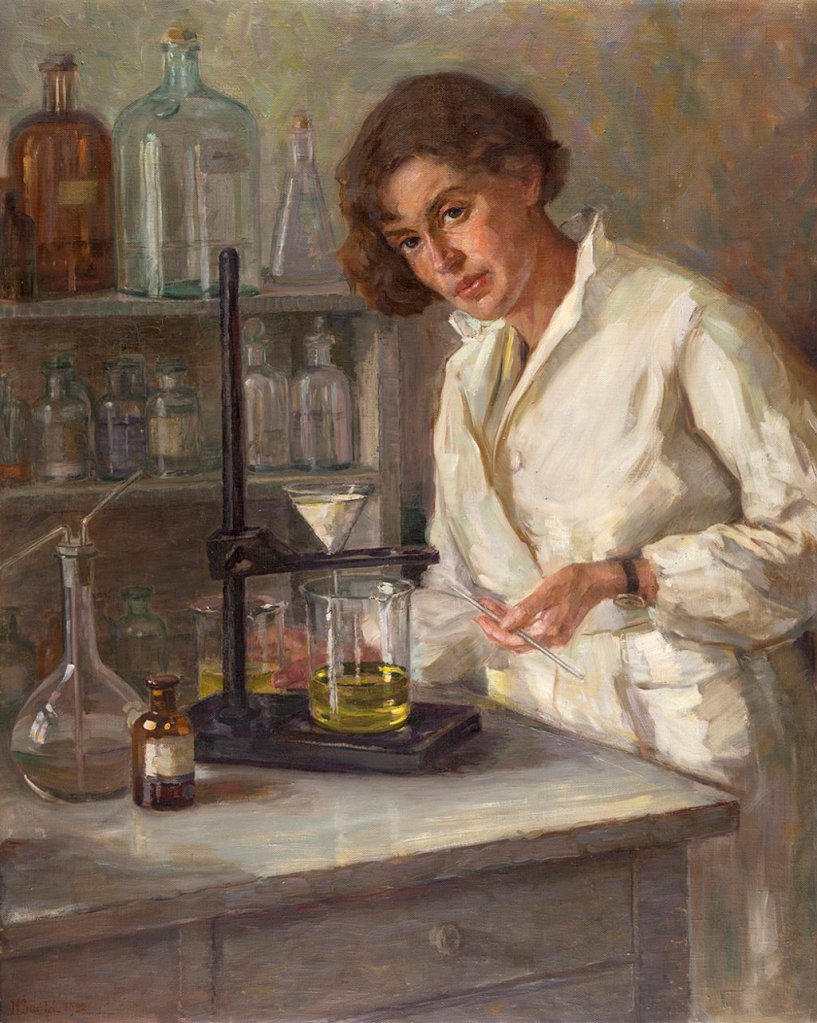
An oil painting of a chemist (by Henrika Šantel in 1932)
In the scope of its subject, chemistry occupies an intermediate position between physics and biology. It is sometimes called the central science because it provides a foundation for understanding both basic and applied scientific disciplines at a fundamental level. For example, chemistry explains aspects of plant chemistry (botany), the formation of igneous rocks (geology), how atmospheric ozone is formed and how environmental pollutants are degraded (ecology), the properties of the soil on the moon (cosmochemistry), how medications work (pharmacology), and how to collect DNA evidence at a crime scene (forensics).

Chemistry addresses topics such as how atoms and molecules interact via chemical bonds to form new chemical compounds. There are two types of chemical bonds: 1. primary chemical bonds e.g covalent bonds, in which atoms share one or more electron(s); ionic bonds, in which an atom donates one or more electrons to another atom to produce ions (cations and anions); metallic bonds and 2. secondary chemical bonds e.g. hydrogen bonds; Van der Waals force bonds, ion-ion interaction, ion-dipole interaction etc.

Etymology
The word chemistry comes from a modification of the word alchemy, which referred to an earlier set of practices that encompassed elements of chemistry, metallurgy, philosophy, astrology, astronomy, mysticism and medicine. Alchemy is often seen as linked to the quest to turn lead or other base metals into gold, though alchemists were also interested in many of the questions of modern chemistry.

The modern word alchemy in turn is derived from the Arabic word al-kīmīā (الكیمیاء). This may have Egyptian origins since al-kīmīā is derived from the Greek χημία, which is in turn derived from the word Kemet, which is the ancient name of Egypt in the Egyptian language. Alternately, al-kīmīā may derive from χημεία, meaning “cast together”.

Modern principles

Laboratory, Institute of Biochemistry, University of Cologne in Germany.
The current model of atomic structure is the quantum mechanical model. Traditional chemistry starts with the study of elementary particles, atoms, molecules, substances, metals, crystals and other aggregates of matter. Matter can be studied in solid, liquid, gas and plasma states, in isolation or in combination. The interactions, reactions and transformations that are studied in chemistry are usually the result of interactions between atoms, leading to rearrangements of the chemical bonds which hold atoms together. Such behaviors are studied in a chemistry laboratory.

The chemistry laboratory stereotypically uses various forms of laboratory glassware. However glassware is not central to chemistry, and a great deal of experimental (as well as applied/industrial) chemistry is done without it.


Solutions of substances in reagent bottles, including ammonium hydroxide and nitric acid, illuminated in different colors
A chemical reaction is a transformation of some substances into one or more different substances. The basis of such a chemical transformation is the rearrangement of electrons in the chemical bonds between atoms. It can be symbolically depicted through a chemical equation, which usually involves atoms as subjects. The number of atoms on the left and the right in the equation for a chemical transformation is equal. (When the number of atoms on either side is unequal, the transformation is referred to as a nuclear reaction or radioactive decay.) The type of chemical reactions a substance may undergo and the energy changes that may accompany it are constrained by certain basic rules, known as chemical laws.

Energy and entropy considerations are invariably important in almost all chemical studies. Chemical substances are classified in terms of their structure, phase, as well as their chemical compositions. They can be analyzed using the tools of chemical analysis, e.g. spectroscopy and chromatography. Scientists engaged in chemical research are known as chemists. Most chemists specialize in one or more sub-disciplines. Several concepts are essential for the study of chemistry; some of them are:

Matter
Main article: Matter
In chemistry, matter is defined as anything that has rest mass and volume (it takes up space) and is made up of particles. The particles that make up matter have rest mass as well – not all particles have rest mass, such as the photon. Matter can be a pure chemical substance or a mixture of substances.

Atom
Main article: Atom

A diagram of an atom based on the Bohr model
The atom is the basic unit of chemistry. It consists of a dense core called the atomic nucleus surrounded by a space occupied by an electron cloud. The nucleus is made up of positively charged protons and uncharged neutrons (together called nucleons), while the electron cloud consists of negatively charged electrons which orbit the nucleus. In a neutral atom, the negatively charged electrons balance out the positive charge of the protons. The nucleus is dense; the mass of a nucleon is approximately 1,836 times that of an electron, yet the radius of an atom is about 10,000 times that of its nucleus.

The atom is also the smallest entity that can be envisaged to retain the chemical properties of the element, such as electronegativity, ionization potential, preferred oxidation state(s), coordination number, and preferred types of bonds to form (e.g., metallic, ionic, covalent).

Element

Standard form of the periodic table of chemical elements. The colors represent different categories of elements
Main article: Chemical element
A chemical element is a pure substance which is composed of a single type of atom, characterized by its particular number of protons in the nuclei of its atoms, known as the atomic number and represented by the symbol Z. The mass number is the sum of the number of protons and neutrons in a nucleus. Although all the nuclei of all atoms belonging to one element will have the same atomic number, they may not necessarily have the same mass number; atoms of an element which have different mass numbers are known as isotopes. For example, all atoms with 6 protons in their nuclei are atoms of the chemical element carbon, but atoms of carbon may have mass numbers of 12 or 13.

The standard presentation of the chemical elements is in the periodic table, which orders elements by atomic number. The periodic table is arranged in groups, or columns, and periods, or rows. The periodic table is useful in identifying periodic trends.

Compound

Carbon dioxide (CO2), an example of a chemical compound
Main article: Chemical compound
A compound is a pure chemical substance composed of more than one element. The properties of a compound bear little similarity to those of its elements. The standard nomenclature of compounds is set by the International Union of Pure and Applied Chemistry (IUPAC). Organic compounds are named according to the organic nomenclature system. The names for inorganic compounds are created according to the inorganic nomenclature system. When a compound has more than one component, then they are divided into two classes, the electropositive and the electronegative components. In addition the Chemical Abstracts Service has devised a method to index chemical substances. In this scheme each chemical substance is identifiable by a number known as its CAS registry number.

Molecule
Main article: Molecule

A ball-and-stick representation of the caffeine molecule (C8H10N4O2).
A molecule is the smallest indivisible portion of a pure chemical substance that has its unique set of chemical properties, that is, its potential to undergo a certain set of chemical reactions with other substances. However, this definition only works well for substances that are composed of molecules, which is not true of many substances (see below). Molecules are typically a set of atoms bound together by covalent bonds, such that the structure is electrically neutral and all valence electrons are paired with other electrons either in bonds or in lone pairs.

Thus, molecules exist as electrically neutral units, unlike ions. When this rule is broken, giving the “molecule” a charge, the result is sometimes named a molecular ion or a polyatomic ion. However, the discrete and separate nature of the molecular concept usually requires that molecular ions be present only in well-separated form, such as a directed beam in a vacuum in a mass spectrometer. Charged polyatomic collections residing in solids (for example, common sulfate or nitrate ions) are generally not considered “molecules” in chemistry. Some molecules contain one or more unpaired electrons, creating radicals. Most radicals are comparatively reactive, but some, such as nitric oxide (NO) can be stable.


A 2-D structural formula of a benzene molecule (C6H6)
The “inert” or noble gas elements (helium, neon, argon, krypton, xenon and radon) are composed of lone atoms as their smallest discrete unit, but the other isolated chemical elements consist of either molecules or networks of atoms bonded to each other in some way. Identifiable molecules compose familiar substances such as water, air, and many organic compounds like alcohol, sugar, gasoline, and the various pharmaceuticals.

However, not all substances or chemical compounds consist of discrete molecules, and indeed most of the solid substances that make up the solid crust, mantle, and core of the Earth are chemical compounds without molecules. These other types of substances, such as ionic compounds and network solids, are organized in such a way as to lack the existence of identifiable molecules per se. Instead, these substances are discussed in terms of formula units or unit cells as the smallest repeating structure within the substance. Examples of such substances are mineral salts (such as table salt), solids like carbon and diamond, metals, and familiar silica and silicate minerals such as quartz and granite.

One of the main characteristics of a molecule is its geometry often called its structure. While the structure of diatomic, triatomic or tetra-atomic molecules may be trivial, (linear, angular pyramidal etc.) the structure of polyatomic molecules, that are constituted of more than six atoms (of several elements) can be crucial for its chemical nature.

Substance and mixture
Quick Facts
A chemical substance is a kind of matter with a definite composition and set of properties. A collection of substances is called a mixture. Examples of mixtures are air and alloys.

Mole and amount of substance
Main article: Mole
The mole is a unit of measurement that denotes an amount of substance (also called chemical amount). One mole is defined to contain exactly 6.02214076×10²³ particles (atoms, molecules, ions, or electrons), where the number of particles per mole is known as the Avogadro constant. Molar concentration is the amount of a particular substance per volume of solution, and is commonly reported in mol/dm3.

Phase

Diagram showing relationships among the phases and the terms used to describe phase changes.
Main article: Phase
In addition to the specific chemical properties that distinguish different chemical classifications, chemicals can exist in several phases. For the most part, the chemical classifications are independent of these bulk phase classifications; however, some more exotic phases are incompatible with certain chemical properties. A phase is a set of states of a chemical system that have similar bulk structural properties, over a range of conditions, such as pressure or temperature.

Physical properties, such as density and refractive index tend to fall within values characteristic of the phase. The phase of matter is defined by the phase transition, which is when energy put into or taken out of the system goes into rearranging the structure of the system, instead of changing the bulk conditions.

Sometimes the distinction between phases can be continuous instead of having a discrete boundary’ in this case the matter is considered to be in a supercritical state. When three states meet based on the conditions, it is known as a triple point and since this is invariant, it is a convenient way to define a set of conditions.

The most familiar examples of phases are solids, liquids, and gases. Many substances exhibit multiple solid phases. For example, there are three phases of solid iron (alpha, gamma, and delta) that vary based on temperature and pressure. A principal difference between solid phases is the crystal structure, or arrangement, of the atoms. Another phase commonly encountered in the study of chemistry is the aqueous phase, which is the state of substances dissolved in aqueous solution (that is, in water).

Less familiar phases include plasmas, Bose–Einstein condensates and fermionic condensates and the paramagnetic and ferromagnetic phases of magnetic materials. While most familiar phases deal with three-dimensional systems, it is also possible to define analogs in two-dimensional systems, which has received attention for its relevance to systems in biology.

Bonding
Main article: Chemical bond

An animation of the process of ionic bonding between sodium (Na) and chlorine (Cl) to form sodium chloride, or common table salt. Ionic bonding involves one atom taking valence electrons from another (as opposed to sharing, which occurs in covalent bonding)
Atoms sticking together in molecules or crystals are said to be bonded with one another. A chemical bond may be visualized as the multipole balance between the positive charges in the nuclei and the negative charges oscillating about them. More than simple attraction and repulsion, the energies and distributions characterize the availability of an electron to bond to another atom.

A chemical bond can be a covalent bond, an ionic bond, a hydrogen bond or just because of Van der Waals force. Each of these kinds of bonds is ascribed to some potential. These potentials create the interactions which hold atoms together in molecules or crystals. In many simple compounds, valence bond theory, the Valence Shell Electron Pair Repulsion model (VSEPR), and the concept of oxidation number can be used to explain molecular structure and composition.

An ionic bond is formed when a metal loses one or more of its electrons, becoming a positively charged cation, and the electrons are then gained by the non-metal atom, becoming a negatively charged anion. The two oppositely charged ions attract one another, and the ionic bond is the electrostatic force of attraction between them. For example, sodium (Na), a metal, loses one electron to become an Na+ cation while chlorine (Cl), a non-metal, gains this electron to become Cl−. The ions are held together due to electrostatic attraction, and that compound sodium chloride (NaCl), or common table salt, is formed.


In the methane molecule (CH4), the carbon atom shares a pair of valence electrons with each of the four hydrogen atoms. Thus, the octet rule is satisfied for C-atom (it has eight electrons in its valence shell) and the duet rule is satisfied for the H-atoms (they have two electrons in their valence shells).
In a covalent bond, one or more pairs of valence electrons are shared by two atoms: the resulting electrically neutral group of bonded atoms is termed a molecule. Atoms will share valence electrons in such a way as to create a noble gas electron configuration (eight electrons in their outermost shell) for each atom. Atoms that tend to combine in such a way that they each have eight electrons in their valence shell are said to follow the octet rule. However, some elements like hydrogen and lithium need only two electrons in their outermost shell to attain this stable configuration; these atoms are said to follow the duet rule, and in this way they are reaching the electron configuration of the noble gas helium, which has two electrons in its outer shell.

Similarly, theories from classical physics can be used to predict many ionic structures. With more complicated compounds, such as metal complexes, valence bond theory is less applicable and alternative approaches, such as the molecular orbital theory, are generally used. See diagram on electronic orbitals.

Energy
Main article: Energy
In the context of chemistry, energy is an attribute of a substance as a consequence of its atomic, molecular or aggregate structure. Since a chemical transformation is accompanied by a change in one or more of these kinds of structures, it is invariably accompanied by an increase or decrease of energy of the substances involved. Some energy is transferred between the surroundings and the reactants of the reaction in the form of heat or light; thus the products of a reaction may have more or less energy than the reactants.

A reaction is said to be exergonic if the final state is lower on the energy scale than the initial state; in the case of endergonic reactions the situation is the reverse. A reaction is said to be exothermic if the reaction releases heat to the surroundings; in the case of endothermic reactions, the reaction absorbs heat from the surroundings.

Chemical reactions are invariably not possible unless the reactants surmount an energy barrier known as the activation energy. The speed of a chemical reaction (at given temperature T) is related to the activation energy E, by the Boltzmann’s population factor {\displaystyle e^{-E/kT}}e^{-E/kT} – that is the probability of a molecule to have energy greater than or equal to E at the given temperature T. This exponential dependence of a reaction rate on temperature is known as the Arrhenius equation. The activation energy necessary for a chemical reaction to occur can be in the form of heat, light, electricity or mechanical force in the form of ultrasound.

A related concept free energy, which also incorporates entropy considerations, is a very useful means for predicting the feasibility of a reaction and determining the state of equilibrium of a chemical reaction, in chemical thermodynamics. A reaction is feasible only if the total change in the Gibbs free energy is negative, {\displaystyle \Delta G\leq 0\,} \Delta G \le 0 \,; if it is equal to zero the chemical reaction is said to be at equilibrium.

There exist only limited possible states of energy for electrons, atoms and molecules. These are determined by the rules of quantum mechanics, which require quantization of energy of a bound system. The atoms/molecules in a higher energy state are said to be excited. The molecules/atoms of substance in an excited energy state are often much more reactive; that is, more amenable to chemical reactions.

The phase of a substance is invariably determined by its energy and the energy of its surroundings. When the intermolecular forces of a substance are such that the energy of the surroundings is not sufficient to overcome them, it occurs in a more ordered phase like liquid or solid as is the case with water (H2O); a liquid at room temperature because its molecules are bound by hydrogen bonds. Whereas hydrogen sulfide (H2S) is a gas at room temperature and standard pressure, as its molecules are bound by weaker dipole-dipole interactions.

The transfer of energy from one chemical substance to another depends on the size of energy quanta emitted from one substance. However, heat energy is often transferred more easily from almost any substance to another because the phonons responsible for vibrational and rotational energy levels in a substance have much less energy than photons invoked for the electronic energy transfer. Thus, because vibrational and rotational energy levels are more closely spaced than electronic energy levels, heat is more easily transferred between substances relative to light or other forms of electronic energy. For example, ultraviolet electromagnetic radiation is not transferred with as much efficacy from one substance to another as thermal or electrical energy.

The existence of characteristic energy levels for different chemical substances is useful for their identification by the analysis of spectral lines. Different kinds of spectra are often used in chemical spectroscopy, e.g. IR, microwave, NMR, ESR, etc. Spectroscopy is also used to identify the composition of remote objects – like stars and distant galaxies – by analyzing their radiation spectra.


Emission spectrum of iron
The term chemical energy is often used to indicate the potential of a chemical substance to undergo a transformation through a chemical reaction or to transform other chemical substances.

Reaction
Main article: Chemical reaction

During chemical reactions, bonds between atoms break and form, resulting in different substances with different properties. In a blast furnace, iron oxide, a compound, reacts with carbon monoxide to form iron, one of the chemical elements, and carbon dioxide.
When a chemical substance is transformed as a result of its interaction with another substance or with energy, a chemical reaction is said to have occurred. A chemical reaction is therefore a concept related to the “reaction” of a substance when it comes in close contact with another, whether as a mixture or a solution; exposure to some form of energy, or both. It results in some energy exchange between the constituents of the reaction as well as with the system environment, which may be designed vessels—often laboratory glassware.

Chemical reactions can result in the formation or dissociation of molecules, that is, molecules breaking apart to form two or more molecules or rearrangement of atoms within or across molecules. Chemical reactions usually involve the making or breaking of chemical bonds. Oxidation, reduction, dissociation, acid-base neutralization and molecular rearrangement are some of the commonly used kinds of chemical reactions.

Staying Organized

Who me? Organized? My husband might tell you otherwise, but I do find it hard to keep track of our weekly schedule. You know: school, swimming, grocery shopping, tidying up, paying bills, remembering appointments and so on. Fortunately, in our house we all pitch in. No one person does everything. But we do have a little secret that helps our day run more smoothly.

Design a site like this with WordPress.com
Get started